Imagine your company’s finance team sitting down to fill out an ESG report. The “E” column Environment stares back. Energy consumption. Water usage. Carbon emissions. Waste management. And somewhere in that list, a question that more investors and clients are now asking: what kind of building does your company operate from?
Most businesses don’t think about this. But the address your company chooses for the building it works out of every day has a direct impact on what you can honestly report under ESG. And that gap in awareness is costing companies a surprisingly easy win
What LEED Gold Certification Actually Means?
LEED stands for Leadership in Energy and Environmental Design. It’s a globally recognised rating system, managed by the US Green Building Council, that scores buildings on how responsibly they’re designed, built, and operated. The rating system has four levels:
- Certified
- Silver
- Gold, and
- Platinum.
A LEED Gold-certified building sits near the top of that scale.
To earn a Gold rating, a building has to meet strict benchmarks across several areas. It needs to use significantly less energy than a standard building of the same size. It needs to manage water efficiently, often reducing consumption by 30% to 40% through smart fixtures and recycled water systems. It needs good air quality indoors, responsible sourcing of construction materials, and a design that reduces long-term environmental load. Every point is documented, verified, and audited.
Why Does That Data Matters More Than Ever?
ESG reporting — Environmental, Social, and Governance, is no longer just something large listed companies do to satisfy regulators. It’s becoming a standard expectation from investors, clients, procurement teams, and even job applicants who want to know whether a company takes its responsibilities seriously.
The “E” portion of ESG is often the hardest to fill with real, verifiable numbers. Most companies can talk about their intent, their commitment to sustainability, and their future goals, but the actual data points are thin. A LEED Gold-certified building changes that. When your office building independently meets and documents high environmental standards, your company automatically inherits those credentials. You didn’t just say you care about energy efficiency. You work in a building that proves it.
For mid-sized businesses that don’t have the resources to run full internal environmental audits, operating out of a certified green commercial space is one of the most practical ways to build genuine ESG credibility. It costs no extra effort. The building does the work.
What does this mean for Businesses in a Growing City Like Thanjavur?
Here’s where the conversation gets interesting for business owners and investors in this part of Tamil Nadu.
ESG reporting has largely been seen as a big-city concern, something relevant to companies in Chennai, Bengaluru, or Mumbai that are dealing with institutional investors or multinational clients. But that’s changing rapidly. As more companies expand into tier-2 markets, and as supply chains become more transparent, ESG expectations are travelling to smaller cities too. A company based in Thanjavur that supplies to a larger firm, or that wants to attract serious outside investment, increasingly needs to speak this language.
The question isn’t whether ESG expectations will reach cities like this. They already have. The question is whether the infrastructure is ready to support them.
Urban infrastructure in Thanjavur has come a long way in a short time, with roads, connectivity, and commercial development. But until recently, the city had very little to offer in terms of green-certified workspace. A business that wanted to tick the right boxes on its ESG report simply didn’t have a green building option here. That’s the gap that’s now being addressed.
When the Building Itself Becomes a Business Asset
A LEED Gold-certified office isn’t just good for the environment. It’s good for business in a set of very specific, practical ways.
Companies that operate out of certified green spaces consistently report lower utility costs over time. Energy-efficient design means smaller electricity bills, month after month. Employees working in buildings with better air quality and natural light report better focus and lower absenteeism. And when a company’s client or investor asks about ESG compliance, the building’s certification gives the team something concrete to point to, rather than a list of intentions.
For a business setting up its workspace solutions in a growing market, these aren’t soft benefits. They feed directly into operational savings, talent retention, and business credibility. Intelligent design in a commercial building isn’t a nice-to-have. It starts paying for itself faster than most people expect.
The Larger Point: Green Spaces Are Becoming the Standard, Not the Exception
There’s a shift happening in how companies, and the people who work for them, think about the buildings they spend their time in. A few years ago, asking whether your office building had a LEED certification would have seemed like an unusually detailed question. Today, it’s becoming a routine.
This shift matters for cities like Thanjavur precisely because they’re at an early stage of commercial growth. The buildings going up now will set the tone for the kind of business city this becomes. Built with certified, future-ready standards, the city attracts companies that think the same way. Build without them, and the city risks becoming a destination for businesses that have already been turned away elsewhere.
Urban development that takes environmental standards seriously isn’t just about doing the right thing. It’s about building the kind of city that serious businesses want to be in, a Tier-2 City Business Hub with the infrastructure to compete, not just participate.
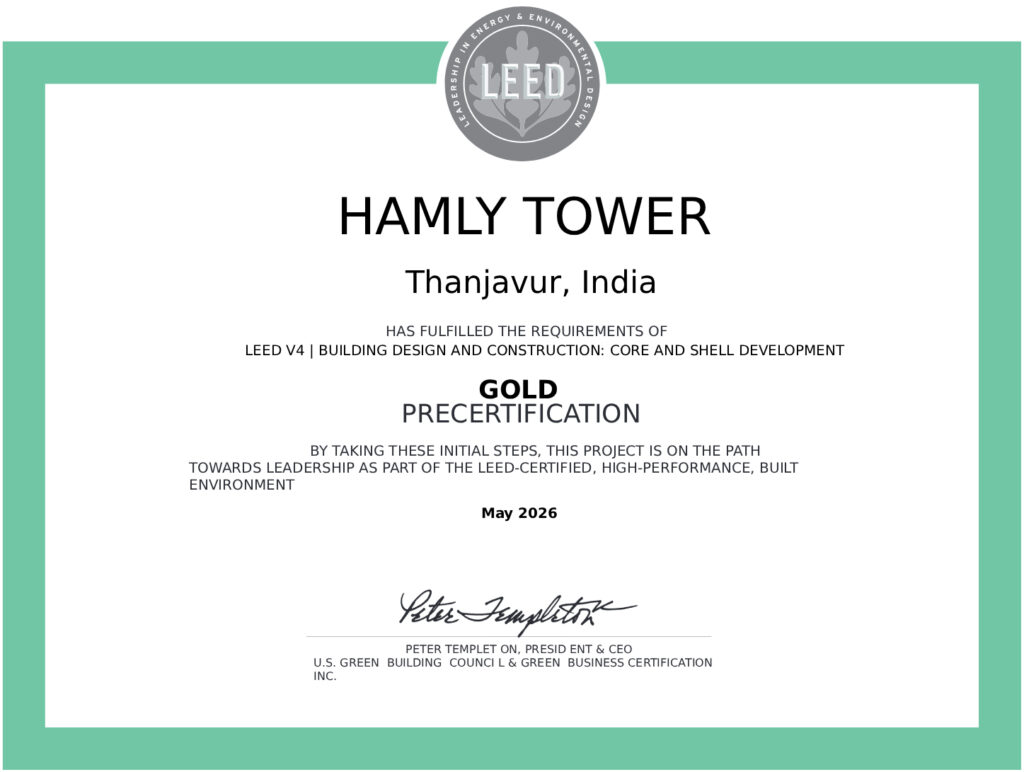
When the Hamly Group, a multi-sector conglomerate with a strong presence across the Cauvery delta region, chose to make BBS Infraspace Hamly Towers a LEED Gold certified development, it wasn’t following a trend. It was making a considered bet on what businesses in Thanjavur would need next. BBS Infraspace, the group’s commercial infrastructure arm, has approached this project as a workspace designed for companies that want to grow responsibly, with real data behind their green claims, not just good intentions.
Hamsavardhan Mohan, the first-generation entrepreneur who built Hamly Group from the ground up, has consistently pushed the group toward investments that serve community empowerment alongside commercial returns. Regional roots, global impact isn’t just a phrase the group uses; it’s visible in a project like this, which brings certified commercial spaces to a city that has long deserved them. The result is a business tower built not just for today’s tenant, but for the direction that business and reporting standards are heading.
Strategic Takeaways: ESG reporting is no longer something you can put off until your company gets bigger. The companies setting up in the right buildings today are going to look noticeably better in the reports they file two and three years from now, and the clients and investors reading those reports are going to notice.
If you’re thinking about where your company should plant its next flag, the building itself is part of the answer.
- Explore what BBS Infraspace Hamly Towers offers
- Learn about the Hamly Group’s vision for commercial development in Thanjavur
Frequently Asked Questions (FAQs)
LEED Gold certification is a globally recognized green building standard awarded to buildings that achieve high performance in energy efficiency, water conservation, indoor environmental quality, and sustainable design.
It provides verified environmental performance data, including energy and water savings, which companies can use to strengthen the environmental component of their ESG reports.
Yes. Energy-efficient systems, water-saving technologies, and optimized building operations often lead to lower utility and maintenance expenses over time.
They help improve sustainability performance, attract environmentally conscious clients and investors, enhance employee well-being, and support long-term business growth.
Yes. Increasingly, clients, investors, and supply chain partners expect businesses of all sizes to demonstrate environmental responsibility and sustainability practices.